

Davis℠ Mastery for Reading
Programmes Available for Dyslexic Adults, Teens, Children and Young Learners
Experiences dizziness, headaches, or stomach aches while reading.
Is confused by letters, numbers, words or sequences.
Reading or writing shows repetitions, additions, transpositions, omissions, substitutions and reversals in letters, numbers and/or words.
Feels or sees non-existent movement while reading, writing or copying.
Seems to have difficulty with vision, yet eye exams don’t reveal a problem.
Spells phonetically and inconsistently.
Trouble with writing or copying; pencil grip is unusual; handwriting varies or is illegible.
Clumsy, uncoordinated, poor at ball or team sports; difficulties with fine and⁄or gross motor skills and tasks; prone to motion-sickness.
Can be ambidextrous, and often confuses left⁄right, over⁄under.
What is Dyslexia?
Difficulty with Reading, Writing, Spelling
Dyslexia is a learning difference where an individual experiences difficulty with written text. It manifests in challenges with reading and writing despite having no intellectual impairments. Some characteristics include:
These challenges of dyslexia are just a few aspects to consider. Embracing the learning difference also means recognising and nurturing the many talents that accompany it.
This is why we firmly believe in harnessing the true gift of dyslexia.
Formal testing is not required to do our learning programmes. At Dyslexia Unpuzzled, we recognise that if you are coming to us, it means that your learning needs are not currently being met.
We do a screening to determine what your current learning challenges are and assess your suitability for the programme. Prior to doing a programme with us we do an assessment so we know how we can best tailor the programme to meet your specific needs.
How can I get Tested
for Dyslexia?
Click below to request access to a FREE online test to determine if you have Dyslexia.
Personalised Consultations:
Everything starts with a free call, a short phone or Zoom conversation where you tell me what's been going on and we work out whether this is the right fit.
If it is, we meet properly, and this is where your child gets to tell me in their own words what's been hard for them, often for the first time.
Forty five minutes with you and your child, $75 including GST.
From there comes the assessment, around two hours, where I pinpoint what's actually getting in the way and confirm which programme is right for them.
$250 including GST, and it's deducted from the total programme cost.
This isn't after school tutoring, it's specialist one to one teaching built around the way your child actually learns, which is why it works when other things haven't.
"Her school was working with her daily and she was making steady progress, but it was slow. She is now reading out loud to us at bedtime instead of us reading to her." (Ana parent 10 year old chid)
If any of this sounds like your family, start with the free call and we'll take it from there.
Email Nikki: dyslexiaunpuzzled@gmail.com
or text/call 0272495074
The Gift of Dyslexia
It was widely believed that dyslexia was a lifelong neurological disorder, but Ronald D. Davis, himself a dyslexic, discovered that this is not the case. Dyslexic people simply have an alternative way of thinking and learning.
Visual Thinking
Dyslexics have strong visual-thinking abilities. This means that instead of thinking in words or internal dialogue like a lot of people do, dyslexics think in 3-dimensional images.
This powerful visual thinking leads dyslexics to have many gifts in:
Creative fields such as visual art, sculpting, film-making
Engineering and building
Craftsmanship, working with 3-dimensional objects
Creative problem-solving and thinking outside the box
But the picture-thinking gift of dyslexia causes problems when it is applied to written text, which is 2-dimensional
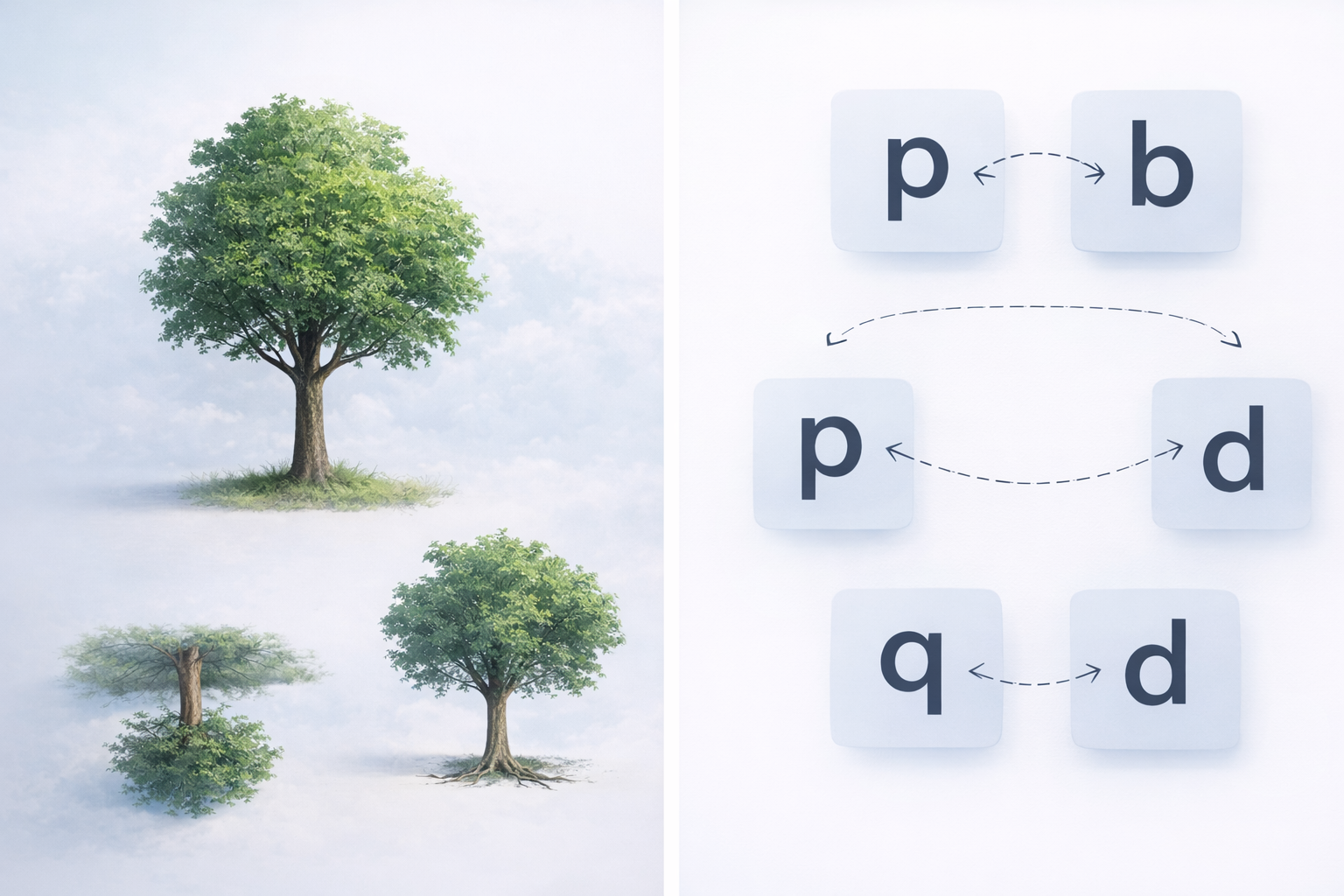
When you look at a 3-dimensional object, you know exactly what it is regardless of the angle you look at it from. For example, a tree is a tree from birds eye view or from front-on view. It is even a tree if you flip it upside down in your mind.
However, letters and words exist in a 2-dimensional form, and their correct meaning is perceived when viewed from one angle, typically straight on.
However, when flipped or rotated, a letter like 'p' takes on a different meaning, becoming 'b.' For dyslexic individuals who possess a unique 3-dimensional thinking style, this can lead them to perceive the 'p' as 'b,' and similarly, 'q' as 'd.'
It's no wonder this can be confusing!
If you have kids who are struggling with dyslexia, the greatest gift you can give them is the sense that nothing is unattainable. With dyslexia comes a very great gift, which is the way that your mind can think creatively.
- Orlando Bloom

Davis℠ Mastery for Dyslexia
A solution for adults, teens and children struggling with dyslexia
The Davis℠ Mastery for Dyslexia Programme is proven to increase reading ability. There is a 97% success rate for clients who complete the full programme.
This is because Davis℠ facilitators don’t focus on what people with dyslexia can't do. We focus on what dyslexics excel at - thinking in three dimensional images and using this natural talent to enhance their learning.

A Davis℠ approach
to dyslexia
Your Davis℠ Mastery for Dyslexia Programme is tailored to your specific literacy needs and include a combination of the following:
Training client to control their perception and focus
Mastering letters, symbols, numbers and words that cause confusion
Improvement in balance and co-ordination
Self-awareness tools for reducing stress and controlling energy levels
Improvement in reading accuracy and comprehension
Tools for improving spelling
Handwriting progress
Growing time management and organisational skills
Techniques for listening attentively
Training in how to use creativity as a learning tool
Writing techniques
How it works
For adults, teens and children 8 and older. For younger children, see the
Davis℠ Reading Programme for Young Learners below.

Dyslexia is not a complexity. It is a compound of simple factors that can be dealt with step by step. At dyslexia’s root is a natural ability - a talent. The gift of dyslexia is the gift of mastery.
-Ron Davis
Davis℠ Reading Programme
for Young Learners
Young learners deserve the best start we can give them. Strong research evidence suggests that children who are exposed to Davis℠ methods at pre-reading or primary level (age 5-7) benefit in the following ways:
They are less likely to develop a learning difficulty.
They are significantly more likely to qualify for gifted programme referrals.
Their basic word recognition will be among the highest levels expected for their age group.
The Davis℠ Reading Programme for Young Learners is based on the Davis℠ Dyslexia Mastery for Reading programme however, is delivered over 10 mornings rather than full days. If the child attends school in the afternoons they are able to put the Davis℠ techniques they have learnt into practice.
A parent or caregiver attends the sessions so that they can continue the techniques at home and do the post-programme work.


Mastering all letters from the upper-case and lower-case alphabet
Learning the function and form of common punctuation marks
Mastering basic words and developing the techniques to learn hundreds more
Reading enhancement
Materials required for post-programme work at home
Three follow-up sessions with the facilitator

The Davis℠ Reading Programme for Young Learners includes:
Contact me for a free chat or let’s connect
face to face for a Discovery Call.
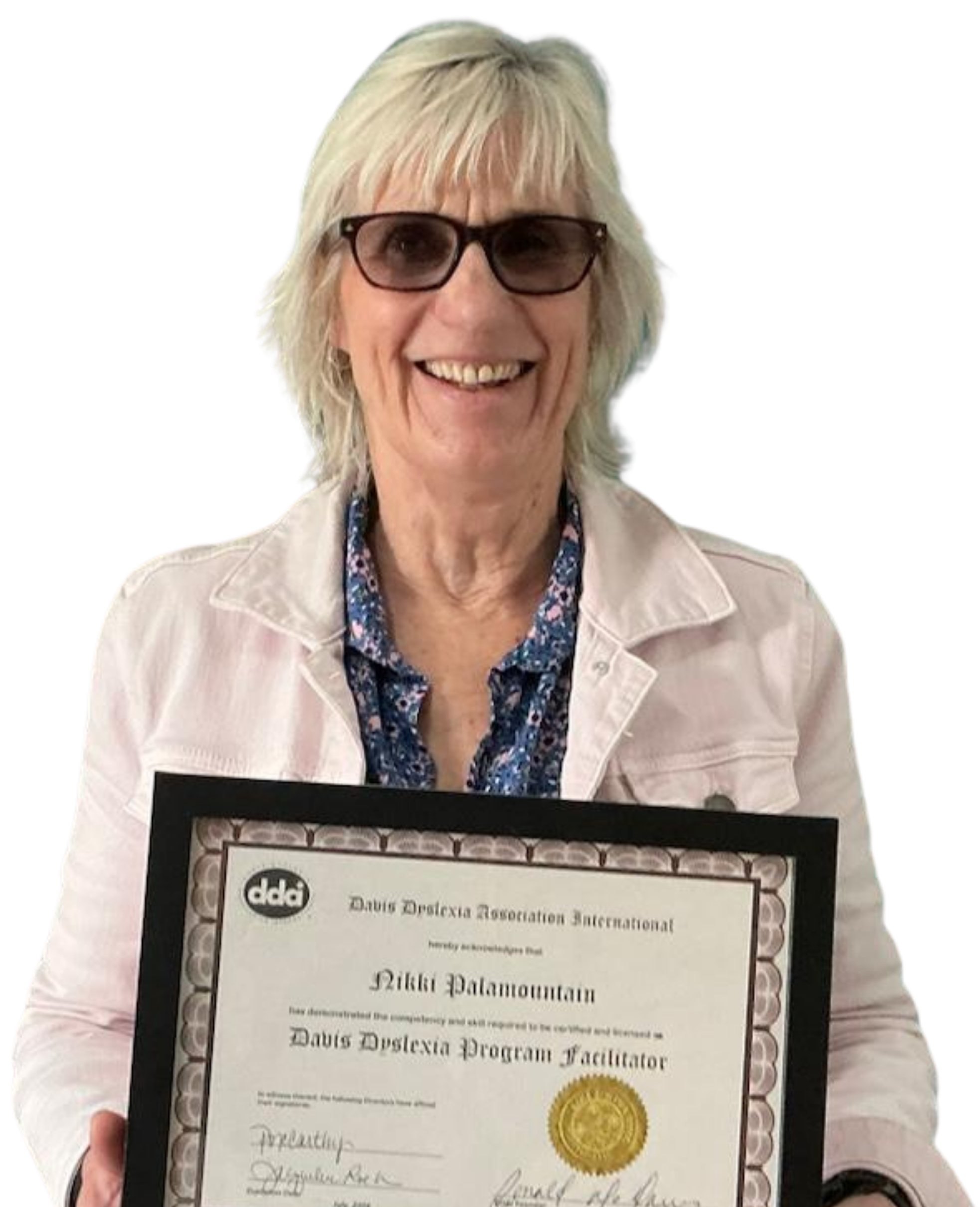
Nikki Palamountain:
Email Nikki: nikki@dyslexiaunpuzzled.co.nz or text/call 0272495074
What about dyslexic adults?
Many adult people with dyslexia have had their lives changed by the Davis Mastery for Reading® Programme. In this TEDx video James Ross explains how his world was transformed at 33 years old when he did the programme and his Davis facilitator helped him understand for the first time in his life how his dyslexic mind worked.
Reach out to us to explore how we can support you as a dyslexic adult and help you achieve your goals with confidence.